
Desktop Database Client
PostgresD
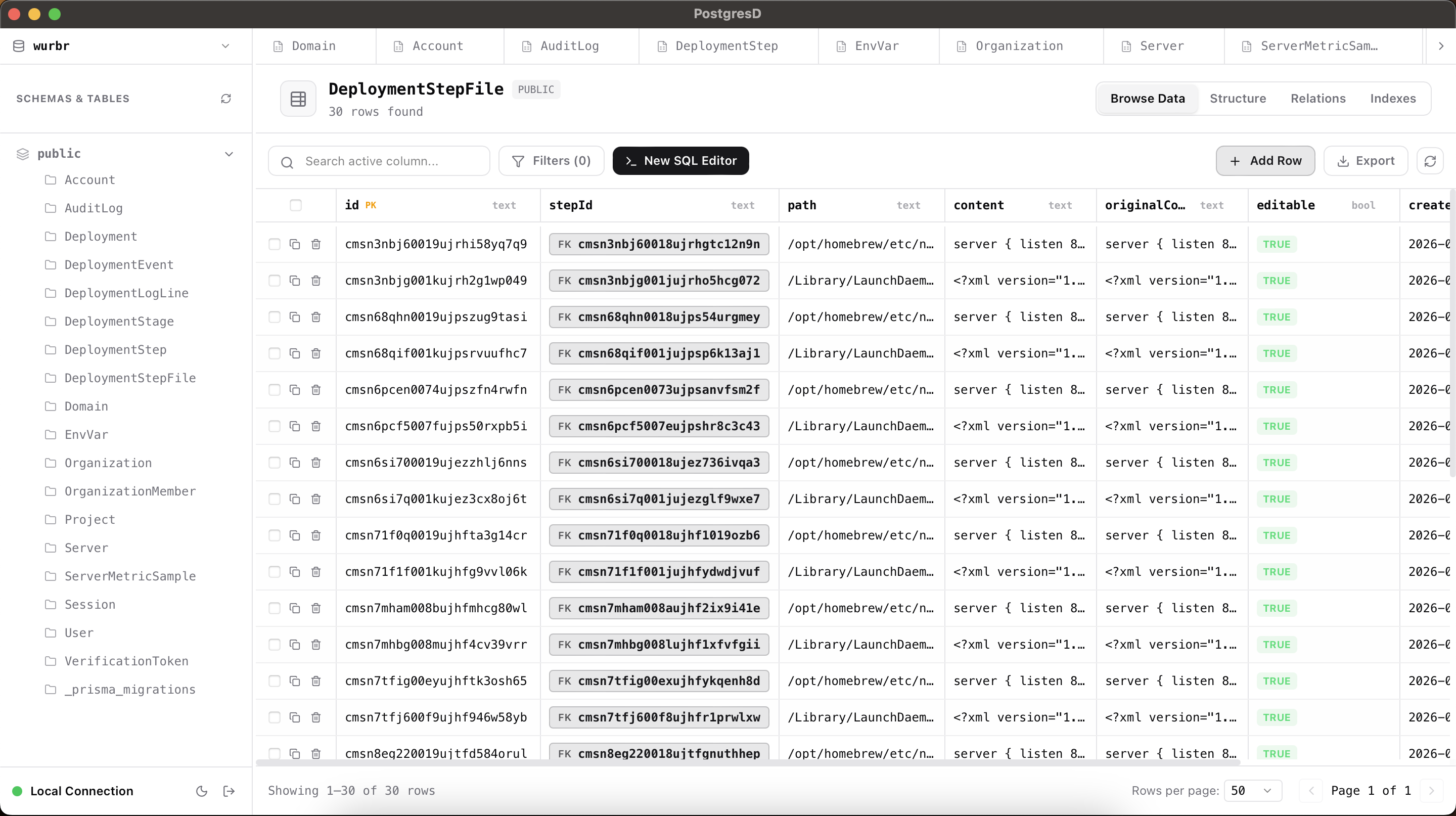
Modern, lightweight desktop PostgreSQL client and database management studio built with Tauri v2, React 19, and Rust, featuring in-place transactional editing, automatic foreign-key relational graph navigation, Monaco SQL workspace with active cancellation, and OS-native keychain credential security.
Executive Summary & Product Vision
01 // SECTIONTraditional database clients (such as pgAdmin, DBeaver, or DataGrip) often suffer from high memory overhead (Electron or Java VM footprints exceeding 400MB+ RAM), cluttered user interfaces with hundreds of nested submenus, and complex workflows for standard CRUD operations.
PostgresD was engineered to solve these pain points by offering: • Minimal Memory Footprint: Powered by Tauri v2 and Rust instead of Chromium/Electron, consuming a fraction of the RAM and CPU (~45MB–80MB baseline RAM). • Prisma Studio-Inspired Relational Navigation: Automatic detection of foreign keys and reverse references, enabling developers to traverse parent and child relations without manually writing JOIN queries. • Instant In-Place Editing: Double-click cell modifications, staging dirty edits with a safety review drawer before batch committing them inside an atomic transaction. • Native Security: Passwords are never stored in plain-text localStorage or JSON configuration files; they are delegated to native OS Keychains (macOS Keychain, Windows Credential Manager, Linux Secret Service). • Developer Ergonomics: Integrated Monaco SQL editor with active query cancellation, stream-based export pipelines, dark/light dynamic theme switching, and pixel-perfect header/footer symmetry.
High-Level System Architecture & IPC Pipeline
02 // SECTIONPostgresD adopts a decoupled architecture separating the desktop presentation layer from native systems programming:
- Presentation Layer (React 19, TypeScript, TailwindCSS v4): Renders the virtualized data grid, Monaco SQL editor, relation overlays, and connection management UI.
- Tauri IPC Bridge: Type-safe command routing executing asynchronous invoke() requests.
- Native Rust Backend (Tokio & SQLx): High-performance asynchronous execution engine divided into modular subsystems:
- Command Handlers: IPC request routers validating payloads.
- Connection Manager: Thread-safe PgPool connection pool caching per database ID.
- Query Registry: Mutex-guarded tracking of active PostgreSQL backend PIDs for non-blocking query cancellation.
- Metadata Extractor: Introspects information_schema and pg_catalog for schemas, tables, columns, indexes, and foreign key graphs.
- Dynamic Executor: Handles generic PostgreSQL type decoding and atomic transaction lifecycles.
- Keyring Engine: Interfaces with native OS credential vaults for secure password storage.
- PostgreSQL Instance: Direct async TCP/TLS connections to cloud or local PostgreSQL databases (versions 12 through 17+).
Interactive Data Grid & Transactional In-Place CRUD
03 // SECTIONData manipulation in PostgresD blends instant UI responsiveness with strict transactional safety:
• Double-Click Cell Editing: Double-clicking any non-primary-key cell turns it into an active inline editor matching its schema type. • Dirty State Accumulator: Edits are staged in memory as PendingChange objects without triggering immediate destructive database writes. Dirty cells are visually highlighted. • Pending Changes Review Drawer: A slide-over panel displays the exact structured diff of pending insert, update, and delete operations with target primary keys and new values. • Atomic Batch Commit (apply_changes): Commits all pending changes within a single PostgreSQL transaction (BEGIN ... COMMIT). If any foreign key or check constraint fails, the entire transaction is rolled back (ROLLBACK) and the exact PostgreSQL error message is displayed. • New Record Modal & Batch Deletion: Auto-generates modal input forms based on column types and nullable flags, and supports multi-row checkbox selection for batch deletions. • Virtualized Performance: Utilizes @tanstack/react-virtual to render only visible DOM nodes, enabling smooth 60 FPS scrolling across 10,000+ row datasets with dynamic drag-to-resize columns.
PostgresD revolutionizes relational database exploration by eliminating manual SQL JOIN writing for standard entity navigation:
• Outgoing Foreign Key Badges: Foreign key columns display a distinct badge with an external link indicator. Clicking the badge extracts the foreign key value and queries the referenced parent record in real time. • Incoming Sub-Relation Synthesizer (Table []): PostgresD inspects the information_schema constraint graph to find all other tables referencing the active table. It synthesizes dynamic virtual count columns (e.g. orders [], reviews []). • Dual-Layout Reference Overlay Sheet:
- Single Parent Record: Rendered as a clean vertical key-value attribute inspection sheet.
- Multiple Child Records: Rendered as a nested, horizontally scrollable relational data table allowing sub-level filtering and inspection.
Monaco SQL Workspace & Asynchronous Query Cancellation
05 // SECTIONFor complex analytical workflows, PostgresD provides an integrated SQL workspace:
• Full Monaco Editor Integration: Complete SQL syntax highlighting, auto-completion, multi-cursor editing, bracket matching, and multi-tab side-by-side query workspaces. • Asynchronous Tokio Execution: Queries run on independent Tokio worker threads, keeping the desktop UI responsive at all times. • Execution Telemetry: Displays accurate millisecond execution timers (execution_time_ms) and total affected row counts. • Active Query Cancellation (pg_cancel_backend): When a query begins, its PostgreSQL backend PID is registered in a thread-safe QueryRegistry. Clicking "Cancel Query" executes SELECT pg_cancel_backend(pid) on an independent connection, terminating long-running queries instantly without severing the client connection.
Rust Backend Architecture & Dynamic Type Decoding
06 // SECTIONBecause runtime table structures are dynamic, SQLx cannot use compile-time macros. PostgresD implements a generic type decoder (pg_row_to_json) matching on PostgreSQL column type OIDs:
• Booleans: BOOL → serde_json::Value::Bool • Integers & Floats: INT2, INT4, INT8, FLOAT4, FLOAT8 → serde_json::Value::Number • Strings & Text: VARCHAR, CHAR, TEXT, BPCHAR → serde_json::Value::String • UUIDs: Decoded via uuid::Uuid to canonical hyphenated strings • JSON / JSONB: Parsed directly into nested serde_json::Value objects • Date & Timestamps: TIMESTAMPTZ, TIMESTAMP, DATE, TIME decoded via chrono to ISO-8601 strings • Arrays & Enums: Homogeneous vector decoding with fallback UTF-8 byte conversion.
Dynamic filter expressions are compiled safely using parameterized SQL (, , ...) and identifier sanitization via quote_ident() to prevent SQL injection.
Multi-Format Streaming Export Engine
07 // SECTIONPostgresD includes a high-throughput export pipeline capable of exporting selected rows or entire tables:
• JSON & CSV Formats: Cleanly serializes records while stripping UI-only virtual relation columns. • Direct-to-Disk Streaming: Full-table exports stream asynchronously from PostgreSQL via sqlx::query().fetch() directly into a csv::Writer backed by std::fs::File, exporting gigabyte-scale datasets without hitting webview memory limits. • Excel Compatibility: Automatically injects a UTF-8 Byte Order Mark () at the start of CSV files, guaranteeing international characters render correctly in Microsoft Excel on Windows and macOS.
Security, Isolation & OS-Native Keychains
08 // SECTIONSecurity is enforced through native operating system integration and strict input hygiene:
• Zero Plain-Text Credentials: Password credentials are never saved in local storage or unencrypted config files. They are stored in native OS credential vaults (macOS Keychain, Windows Credential Manager, Linux Secret Service) via keyring-rs. • Parameterized Query Execution: All filter builder queries and mutation statements use parameterized SQL (, ), eliminating SQL injection vectors. • Identifier Sanitization: Schema, table, and column names are wrapped with quote_ident() to prevent identifier injection. • Sandboxed Desktop Runtime: The webview runs with minimal privileges restricted by Tauri v2 capability configuration files.
Testing Environment, CI/CD & Cross-Platform Distribution
09 // SECTIONThe project includes a comprehensive local Docker development environment and multi-platform build pipeline:
• Docker Relational Test Suite: Provides a complete e-commerce test schema (users, categories with self-referencing hierarchies, products, orders, order items, reviews, and JSONB audit logs). • Automated GitHub Actions CI/CD: Multi-target release workflow triggering on version tags to compile universal binaries for macOS (.dmg, .app), Windows (x86_64 NSIS .msi, .exe), and Linux (.deb, AppImage) with automated GitHub release drafting.
Highlights
10 // SECTION-
Native Speed & Minimal Footprint: Tauri v2 + Rust architecture consuming ~45MB–80MB baseline RAM compared to 400MB+ for Electron-based clients.
-
Prisma Studio-Style Relational Navigation: 1-click foreign key inspection and incoming sub-relation virtual count columns (Table []) for zero-JOIN traversals.
-
Transactional In-Place Editing: Double-click inline cell edits staged in memory with diff review drawer and atomic multi-row transaction commits.
-
OS-Native Keychain Security: Passwords stored securely in macOS Keychain, Windows Credential Manager, and Linux Secret Service via keyring-rs.
-
Monaco SQL & Active Cancellation: Full-featured SQL workspace with asynchronous execution and non-blocking pg_cancel_backend query aborts.
-
Virtualized Grid & Streaming Exports: 10,000+ row virtualized rendering at 60 FPS and direct-to-disk streaming CSV exports with UTF-8 BOM.
Outcome & Status
11 // SECTIONShipped a production-ready, open-source cross-platform desktop PostgreSQL management studio distributed across macOS (.dmg, .app), Windows (.msi, .exe), and Linux (.deb, AppImage).